
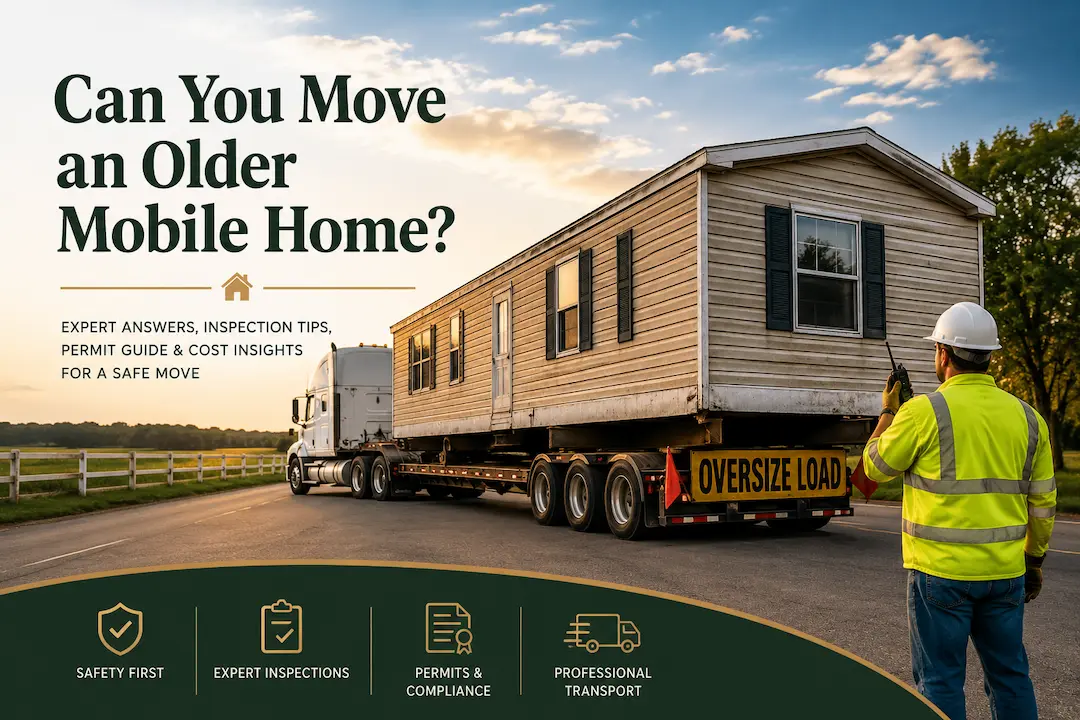
Can You Move an Older Mobile Home? The Complete Guide to Relocating an Aging Manufactured Home
If you’re asking yourself, “Can you move an older mobile home?” you’re not alone. Thousands of homeowners across the country face this exact question every year. The short answer is yes—but the real answer depends on a handful of critical factors that determine whether your aging mobile home can survive the journey, whether local laws will allow it, and whether moving it makes financial sense in the first place.
I’ve spent years helping homeowners navigate the complexities of manufactured home relocation. What I can tell you is this: moving an older mobile home is nothing like moving a traditional house. The stakes are higher, the rules are stricter, and the margin for error is razor-thin. But with the right information, the right team, and realistic expectations, relocation is absolutely achievable for many older homes.
Let me walk you through everything that matters—from inspections and permits to costs and practical alternatives. By the end of this guide, you’ll know exactly whether moving your aging mobile home is the right call for your situation.
Table of Contents
- 1. The HUD Divide: Why 1976 Matters
- 2. State & County Age Restrictions
- 3. Structural Integrity: What Makes a Home Transport-Ready
- 4. The Mobile Home Inspection Process
- 5. Permits and Paperwork
- 6. The Complete Moving Process Step by Step
- 7. Cost Breakdown: What to Budget
- 8. Single-Wide vs. Double-Wide
- 9. The Financial Reality Check
- 10. Frequently Asked Questions
The HUD Divide: Why 1976 Matters More Than You Think
Before we get into anything else, we need to address the elephant in the room: June 15, 1976. That’s the date the U.S. Department of Housing and Urban Development (HUD) implemented the HUD Code for manufactured homes. Homes built before that date are technically “mobile homes.” Homes built on or after are “manufactured homes.”

This distinction isn’t just semantics. It’s the single most important factor in whether you can move an older manufactured home.

Pre-HUD Mobile Homes: The Hard Truth
If your home was built before June 15, 1976, most states will not allow it to be moved. Period. These homes were built to inconsistent standards, and many lack the structural integrity to survive transport. Some jurisdictions might permit relocation if the home undergoes extensive upgrades and passes a rigorous inspection, but these cases are the exception, not the rule.
For post-1976 homes, you have more options—but age still matters. Even a HUD-certified home that’s 30 or 40 years old faces significant hurdles. The HUD data plate (typically found inside a kitchen cabinet, bedroom closet, or near the electrical panel) confirms the home was built to federal standards. If that plate is missing, expect delays and complications.
One important note: while HUD sets federal construction standards, state and local governments control relocation rules. Some jurisdictions, like Illinois, have proposed legislation preventing local governments from restricting mobile home moves based solely on age. But these laws are rare. In most places, age remains a primary factor in approval decisions.
For more detailed information about HUD standards, visit the HUD Manufactured Housing Program.
State and County Age Restrictions: The 20-Year Rule and Beyond
Here’s where things get complicated. There’s no single federal age limit for moving a mobile home. Instead, each state—and sometimes each county—sets its own rules. This patchwork of regulations makes it essential to check local requirements early in your planning process.
| State | Age Policy | Key Considerations |
|---|---|---|
| Florida | 20-year rule in many counties | Homes older than 20 years often cannot be moved regardless of condition |
| Texas | Stricter inspections for homes over 10 years | Age isn’t an automatic ban, but older homes face additional scrutiny |
| North Carolina & Georgia | Focus on HUD compliance over age | Post-1976 homes may qualify even past 20–30 years with proper certification |
| Alabama & Mississippi | 15–20 year bans in some counties | Some areas prohibit relocation regardless of condition |
Tulare County, California, takes an even stricter approach. Any pre-HUD mobile home moved into the county must be inspected to ensure compliance with current health and safety standards. Other counties require that any mobile home over ten years old pass a supplemental inspection before relocation.
Important: Even if your state allows older home moves, the destination community—whether a mobile home park or private land—may have its own age restrictions. Many well-maintained communities set minimum age standards to protect property values and ensure quality housing. Check with the destination BEFORE you start the moving process.
Check your state’s specific requirements through the Federal Motor Carrier Safety Administration (FMCSA) and your local Department of Transportation.
Structural Integrity: What Makes a Home Transport-Ready
Legal approval is one hurdle. Physical survivability is another. Transporting a mobile home subjects the structure to forces it was never designed to experience during daily living. The home will bounce, twist, and flex as it travels down highways. If the structure can’t handle that stress, you could end up with a collapsed home halfway to its destination.
Key Structural Components That Must Pass Inspection
- The Steel Chassis: The backbone of your home. Rust, corrosion, or previous damage can compromise its ability to support the home during transport.
- Axles and Tires: If your home has been stationary for years, the tires may be rotted and axles rusted. These may need replacement before the home can be moved.
- Frame Integrity: Sagging floors, especially near the center of the home, indicate frame issues that make relocation risky.
- Roof Condition: A failing roof may collapse during transport. Movers will check for soft spots, leaks, and structural weakness.
- Hitch Assembly: The connection point where the home attaches to the towing vehicle must be sound.
As one professional put it, “A home can look move-ready from the porch and still be a hard no for transport once the inspection starts.” This is why experienced mobile home moving services never offer blanket approvals—they inspect first, then decide.

Homes with significant add-ons like decks, porches, awnings, and carports face additional complications. These must be removed before transport, which adds time and expense. In some cases, permanent additions have become so integrated with the home that separating them without damage is nearly impossible.

The Mobile Home Inspection Process: What Professionals Look For
A professional mobile home inspection is non-negotiable if you’re serious about moving an older manufactured home. This isn’t the same as a standard home inspection for a buyer. You need someone who specializes in mobile home transport and knows exactly what to check.

What a Transport-Focused Inspection Covers
- Frame and undercarriage condition — checking for rust, corrosion, and structural weakness
- Roof integrity — looking for leaks, soft spots, and structural soundness
- Floor system — identifying soft or sagging areas that indicate frame problems
- Windows and doors — ensuring they close properly and can be secured for transport
- Exterior siding — checking for damage that could worsen during transit
- Axle and tire condition — determining if the running gear is safe for the road
- HUD data plate and certification labels — confirming compliance and documentation
This inspection serves two purposes. First, it tells you whether the move is realistic. Second, it identifies repairs that will be required before permits, transport, and setup can move forward. Skip this step, and you’re gambling with your home—and your money.
Many interstate mobile home movers offer inspection services as part of their quote process. Take advantage of this. The inspection fee is cheap compared to the cost of a failed move.
Permits and Paperwork: What You’ll Need to Move
Moving an older mobile home involves more paperwork than you might expect. Here’s what you’ll likely need:

Essential Documents
- Title and proof of ownership — verifying you own the home free and clear (or have lender approval to move it)
- Tax clearance certificate — proof that all property taxes are paid to date
- Transport permits — issued by state DOT for oversized loads on highways
- Local moving permits — required by cities and counties for relocation within their jurisdiction
- Setup permits — required at the destination for installation and occupancy
- Insurance documentation — covering the home during transit
Who Handles What?
In most cases, the mobile home moving company handles highway transport permits and route surveys. The homeowner is typically responsible for the tax certificate, title documentation, and any building permits required at the destination. Some full-service movers will handle everything for an additional fee.
Permit costs vary significantly by state and local jurisdiction. Expect to pay anywhere from $100 to over $2,000 for required permits, depending on the complexity of your move.

Pro Tip: Start the permit process early—ideally 1–3 weeks before your planned move date. Delays in paperwork are the most common reason mobile home moves get postponed.
An important note: moving without proper permits can result in significant fines, failed inspections, or the home being denied placement at the new site. This isn’t optional—it’s essential.
Learn more about permit requirements at the FMCSA regulations page and your state’s Department of Transportation website.
The Complete Moving Process Step by Step
If you decide to proceed with moving your older mobile home, here’s what the process looks like from start to finish:
- Initial Consultation and Inspection — A professional mover evaluates your home’s condition and provides a preliminary assessment.
- Quote and Service Selection — You receive a detailed estimate and choose between transport-only or full-service options.
- Permit Acquisition — All necessary permits are secured (handled by either you or your mover).
- Utility Disconnection — Electricity, water, gas, and sewer lines are safely disconnected by licensed professionals.
- Preparation — Skirting, porches, awnings, and other attachments are removed. Interior belongings are packed and secured.
- Loading — Single-wides are lifted as one unit onto a specialized trailer. Double-wides and triple-wides are separated into sections.
- Transport — The home is moved along a pre-planned route, often with escort vehicles for oversized loads.
- Delivery and Setup — The home is positioned on the new site, leveled, and secured to its foundation.
- Utility Reconnection — All utilities are reconnected and tested.
- Final Inspection — A local official inspects the setup and issues a certificate of occupancy.

Cost Breakdown: What to Budget for Relocation
Moving an older mobile home isn’t cheap. Here’s a realistic breakdown of what you can expect to pay:
| Cost Item | Estimated Range | Notes |
|---|---|---|
| Single-Wide Local Move (under 50 miles) | $3,000 – $8,000 | Does not include setup or permits |
| Double-Wide Local Move (under 50 miles) | $8,000 – $15,000 | Larger homes require more equipment and labor |
| Full-Service Move (including setup) | $10,000 – $20,000+ | Includes teardown, permits, utilities, and setup |
| Long-Distance Transport | $5,000 – $15,000+ | Distance and home size drive costs up |
| Permits | $100 – $2,000+ | Varies significantly by jurisdiction |
| Utility Disconnection/Reconnection | $500 – $2,000+ | Requires licensed professionals |
| Site Setup (Leveling, Foundation) | $500 – $2,000+ | Depends on land conditions and foundation requirements |
| Escort Vehicles/Pilot Cars | Varies by route | Required for larger homes on certain routes |
These costs add up quickly. For many homeowners, the total relocation cost approaches or exceeds the actual market value of an older manufactured home. That’s why the financial analysis matters just as much as the logistical one.
Single-Wide vs. Double-Wide: How Size Changes Everything
Your home’s configuration dramatically affects both the feasibility and cost of relocation.

Single-wide mobile homes are generally easier and less expensive to move. They can often be transported as a single unit without splitting. The cost to move a single-wide locally typically ranges from $3,000 to $8,000.
Double-wide mobile homes present more challenges. They must be split into sections for transport, which means more labor, more equipment, and more setup work at the destination. Transport costs for double-wides can reach $8,000 to $15,000 for local moves, with long-distance moves costing significantly more.
Larger multi-section homes require additional planning. Route restrictions, bridge weight limits, and overhead clearances all become more complicated with wider loads. Many states require multiple escort vehicles for larger homes, adding to the cost.
One often-overlooked factor: the weight of personal belongings. Movers typically recommend removing most or all furniture and possessions before transport. These items add weight that stresses the home’s frame and can shift dangerously during transit.
The Financial Reality Check: Is Moving Worth It?
Here’s the question that ultimately matters: does moving your older mobile home make financial sense? Sometimes the answer is yes. Often, it’s no. Here’s how to make that determination.
The Valuation Test
Compare the total cost of moving (including inspections, repairs, permits, transport, setup, and utility work) against the current market value of your home in its existing location. If moving costs approach or exceed the home’s value, relocation probably doesn’t make financial sense.
When Moving Makes Sense
- Your home is in excellent condition — well-maintained, structurally sound, and relatively modern
- The distance is short — local moves cost significantly less than long-distance relocations
- The destination offers advantages — lower lot rent, better community, proximity to family
- You own the home free and clear — no lender approval complications
When Moving Doesn’t Make Sense
- Pre-1976 construction — most jurisdictions won’t allow relocation at all
- Significant structural issues — repairs required before transport may be cost-prohibitive
- Long distance moves — transport costs escalate quickly with distance
- Home has depreciated significantly — moving costs exceed the home’s value
Some homeowners find a creative alternative: selling the home where it sits. This can be more cost-effective than relocation, especially for older homes with limited remaining useful life. Others use the moving opportunity as a reason to upgrade to a newer manufactured housing unit built to modern HUD standards.
As one expert noted, “If the move triggers major repair work, the math can change fast.” Before committing to relocation, get multiple quotes, consider all costs, and make an honest assessment of whether your home is worth moving.

Frequently Asked Questions

Can you move a mobile home built before 1976?
What is the 20-year rule for moving mobile homes?
How much does it cost to move an older mobile home?
Can you move an older mobile home yourself?
Do mobile home parks accept older homes?
What permits are needed to move a mobile home?
How long does it take to move a mobile home?
Ready to Explore Your Mobile Home Moving Options?
Moving an older mobile home is a major decision with significant financial and logistical implications. The best way to determine if your home qualifies for relocation is to get a professional assessment from experienced interstate mobile home movers who understand the rules, the costs, and the risks.
At Interstate Mobile Home Movers, we’ve helped hundreds of homeowners across the country navigate the complexities of manufactured home relocation. From initial inspections and permit acquisition to transport and final setup, we handle the details so you don’t have to.
Request Your Free Mobile Home Moving Quote
Not ready to request a quote? Explore our comprehensive moving services or learn about our safety and insurance standards. For those considering an interstate move, our interstate relocation guide covers everything you need to know about moving across state lines. And don’t forget to review oversize load permit requirements before you begin.
Whether you decide to move your older manufactured home or explore other housing options, we’re here to provide the expert guidance you need to make the right decision for your situation.
