
The Definitive Guide to Shed Moving
Everything you need to know about moving a shed — costs, methods, permits, preparation, and when to hire a professional. Whether it’s a garden shed, storage barn, or portable building, this guide covers it all.
What Is Shed Moving?
Shed moving is the process of relocating a storage shed, garden shed, barn, or outbuilding from one location to another — either within the same property or to an entirely different site. Unlike demolishing and rebuilding, shed moving preserves the original structure and saves the cost of new materials and construction.
A professional shed moving operation typically involves lifting the structure off its foundation, loading it onto a specialized trailer or set of skids, transporting it to the new location, and placing it on a prepared pad or foundation. For larger sheds or moves that cross public roads, oversize permits and escort vehicles may be required.
The complexity of a shed move depends on several factors: the shed’s size, weight, construction material (wood, metal, vinyl), foundation type, distance to the new location, and whether public roads are involved. A small 8×10 wood shed on a flat yard might be slid on skids with a pickup truck. A 16×40 barn or commercial storage building requires a crane, hydraulic trailer, and permit coordination — that’s where professional shed moving services come in.
How Much Does It Cost to Move a Shed?
This is the most common question homeowners ask. How much does it cost to move a shed? The answer depends on the shed’s size, weight, distance, access conditions, and whether you need foundation work at the new site.
| Shed Size | On-Property Move | Local (Under 30 mi) | Long Distance (30+ mi) |
|---|---|---|---|
| Small (8×10 or under) | $200 – $600 | $500 – $1,500 | $1,200 – $3,000 |
| Medium (10×12 to 12×16) | $400 – $1,000 | $1,000 – $3,000 | $2,500 – $5,000 |
| Large (12×20 to 14×40) | $800 – $2,000 | $2,000 – $5,000 | $4,000 – $8,000+ |
| Barn / Commercial (16×40+) | $1,500 – $4,000 | $3,500 – $8,000 | $6,000 – $15,000+ |
What drives the cost up: weight (concrete slab foundations are heavier than skid-built sheds), narrow access requiring crane work, utility lines that need to be moved, road closures, oversize permits for public roads, and foundation prep at the destination.
“For a standard 12×16 garden shed on skids, most homeowners pay between $1,000 and $3,000 for a local professional move — including pickup, transport, and placement at the new site.”
— Typical market range, 2026We provide free, itemized quotes so you know exactly what you’re paying for. No hidden fees, no surprise charges at delivery. Request your free shed moving estimate.
Shed Moving Methods & Equipment
There are several ways to move a shed, ranging from low-tech DIY approaches to professional-grade operations. The right method depends on the shed’s size, weight, and how far it needs to go. Here’s what’s used for garden shed moving and larger structures:
Skid & Drag Method
The shed is lifted, 4×6 or 6×6 skids are placed underneath, and the structure is pulled with a truck, tractor, or winch. Best for short on-property moves on flat ground. Works for sheds under 12×16.
Roller & Pipe Method
Steel pipes are placed under the shed as rollers. The structure is pushed or pulled across them, repositioning pipes as it moves. Low-cost but labor-intensive — best for moves under 100 feet.
Forklift or Telehandler
A forklift slides forks under the shed floor joists, lifts the entire structure, and carries it to the new pad. Fast for on-property moves where access is clear. Requires a level path.
Professional Trailer (Mule / Hydraulic)
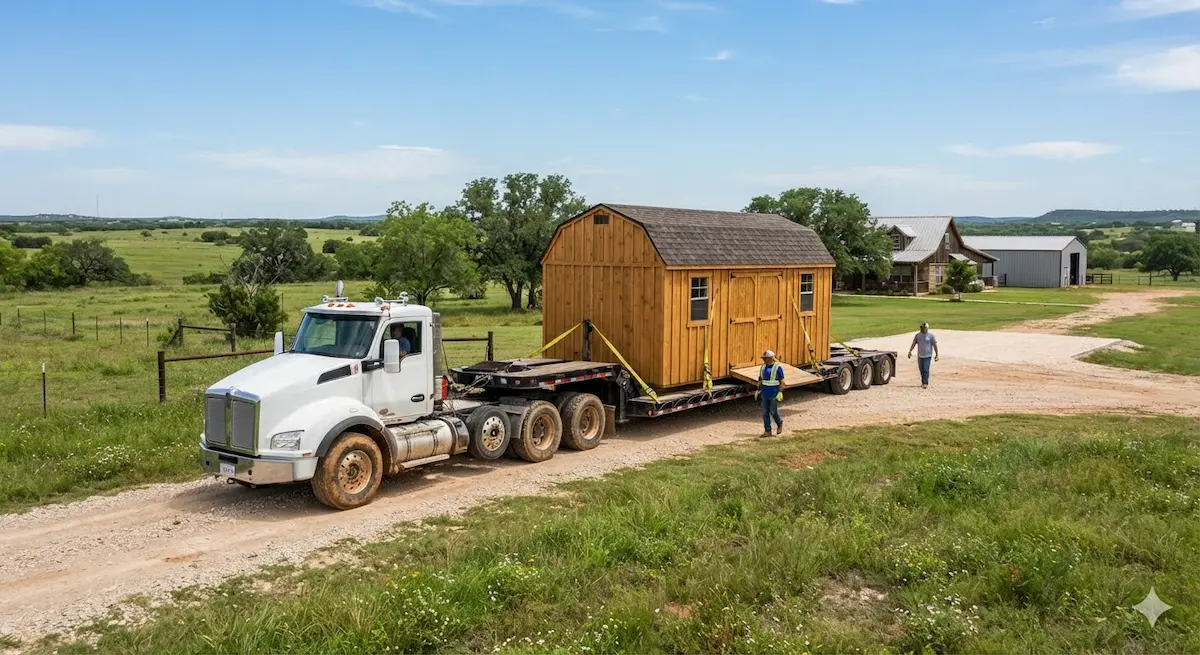
A shed-moving trailer (sometimes called a “mule”) backs under the shed using hydraulic lifts, then carries it on-road to the new location. This is how most professional shed movers handle local and long-distance moves.
For garden shed moving across a yard, the skid method works well for lightweight wood or vinyl sheds. For anything crossing a public road — or any shed over 12 feet wide — a professional trailer and oversize permits are typically required.
Need a Shed Moved?
Whether it’s a garden shed, storage barn, or portable building — we lift, load, transport, and place it at the new site. Free quotes, no obligations.
Get Your Free Estimate Or call: (434) 202-4614DIY vs. Hiring Professional Shed Movers
Is it cheaper to move a shed yourself or hire a pro? Here’s an honest comparison:
| Factor | DIY | Professional Shed Movers |
|---|---|---|
| Best for | Small sheds, short on-property moves | Any size, any distance, road crossings |
| Typical cost | $100 – $500 (equipment rental) | $500 – $8,000+ (full service) |
| Equipment needed | Floor jacks, skids, truck/tractor, straps | Hydraulic trailer, crane, flatbed |
| Risk of damage | High — sheds twist, doors jam, walls crack | Low — pros brace and lift evenly |
| Permits | Your responsibility | Handled for you |
| Insurance | Your homeowner’s policy (maybe) | Carrier liability coverage |
| Foundation prep | You do it | Often included or coordinated |
| Time | Half day to full day + helpers | 2–4 hours (local moves) |
“If your shed is over 10×12, needs to cross a road, or you don’t have a tractor — hire a professional. The cost difference between DIY and pro is smaller than most people think, and the risk of structural damage during an amateur move is high.”
Looking for shed movers near me? Interstate Mobile Home Movers provides professional shed relocation across 30+ states. We assess every structure before the move and use the right equipment for safe transport. Contact us to discuss your project.
How to Prepare Your Shed for Moving
Whether you’re moving the shed yourself or hiring a pro, proper preparation prevents damage:
Before Move Day
- Remove everything inside — tools, shelving, stored items, anything loose
- Disconnect electricity if wired (hire an electrician to safely disconnect)
- Disconnect water lines if the shed has plumbing
- Remove exterior attachments — ramps, awnings, planters, lean-tos
- Trim trees and bushes along the path to the new location
- Verify the new pad/foundation is ready — level gravel pad, concrete blocks, or poured slab
- Measure access: gate widths, fence gaps, overhead clearance
Structural Assessment (Pro Tip)
- Check floor joists for rot — damaged joists can fail under lifting stress
- Check wall-to-floor connections — weak connections cause the walls to separate during lifting
- Check roof integrity — sagging rafters can collapse when the structure flexes in transit
- Metal sheds: check for rust at base — rust weakens the structure where lifting forces are highest
Permits & Regulations for Shed Moving
Permit requirements depend on your local jurisdiction and whether the shed crosses public roads:
When you need a permit
On-property moves (staying on the same lot) generally don’t require a transport permit — but you may need a building permit if the shed exceeds your local square footage threshold (commonly 120–200 sq ft) or if it’s being placed on a new foundation.
Public road crossings require oversize-load permits from your state DOT if the shed exceeds 8’6″ in width. Most sheds are 8–14 feet wide, so most road moves need a permit. In Texas, permits are filed through TxDMV. In Virginia, through VDOT.
What’s the biggest shed you can have without a permit?
This varies by jurisdiction. Most counties allow sheds under 120–200 square feet without a building permit. Some allow up to 400 sq ft. Check your local building codes — setback requirements (distance from property lines) also apply regardless of size.
We handle all transport permits for you when you hire Interstate Mobile Home Movers. Building permits at the destination remain the homeowner’s responsibility, but we’ll advise you on what’s needed.
Types of Sheds We Move
Wood Storage Sheds
The most common type. Stick-built or prefab wood sheds on skids, blocks, or gravel pads. Most are 8×10 to 14×40. Moved on hydraulic trailers or skids.
Metal & Steel Sheds
Lighter than wood but more prone to twisting and panel separation during lifting. Requires careful bracing and even lift points to prevent warping.
Vinyl & Resin Sheds
Lightweight and easy to move if small. Larger vinyl sheds (10×12+) still need professional handling to avoid cracking panels during transport.
Barns & Large Outbuildings
Two-story barns, horse barns, and workshop buildings require crane lifts, oversize permits, and sometimes route surveys for overhead clearances.
Portable Buildings & Offices
Modular offices, job site trailers, and portable classrooms. These are often built on steel frames specifically designed for transport.
Greenhouses & Garden Structures
Glass or polycarbonate greenhouses require extra care — panels must be secured or removed before transport to prevent cracking and shattering.
Our Shed Moving Services
Interstate Mobile Home Movers provides professional shed moving services for homeowners, contractors, and businesses across 30+ states. We don’t just haul the shed — we manage every detail from assessment to placement.
What’s Included
- On-site structural assessment before the move
- Interior bracing and wall securement
- Lifting with hydraulic trailer, forklift, or crane (matched to structure size)
- Transport on specialized trailer — local or interstate
- Oversize permits and escort coordination for road moves
- Placement on prepared pad, blocks, or foundation at the new site
- Leveling and shimming after placement
- Debris cleanup at the pickup location
If you’re searching for shed movers near me, we likely serve your area. We operate across Virginia, Texas, Florida, North Carolina, South Carolina, Maryland, and 24+ additional states. Request a free quote.
Where to Find Shed Movers Near Me
When searching for shed movers near me, look for a company with its own equipment (not a broker), structural moving experience, and permit coordination capabilities. Interstate Mobile Home Movers checks every box — and we serve 30+ states:
States We Serve for Shed Moving
- Texas — Houston, Dallas, San Antonio, Austin, statewide
- Virginia — Richmond, Northern VA, Hampton Roads, statewide
- Florida — Jacksonville, Tampa, Orlando, statewide
- North Carolina — Charlotte, Raleigh, Greensboro, statewide
- South Carolina — Greenville, Charleston, Columbia, statewide
- Maryland — Baltimore, Frederick, statewide
- + 24 more states — See all service areas
Shed Moving FAQ
How much does it cost to move a 12×16 shed?
For a standard 12×16 wood shed, expect to pay $1,000–$3,000 for a local move (under 30 miles). On-property moves run $400–$1,000. Long-distance transport can cost $2,500–$5,000+ depending on distance and permits needed. Get a free quote for your exact situation.
Is it cheaper to move a shed or build a new one?
In most cases, moving is cheaper. A new 12×16 wood shed costs $4,000–$10,000+ depending on quality. Moving the same shed locally costs $1,000–$3,000. The savings are even greater for larger or custom-built sheds that would be expensive to replicate.
Can I move a shed that’s already installed?
Yes — most sheds can be moved even if they’ve been installed for years. Sheds on skids, blocks, or gravel pads are the easiest. Sheds bolted to concrete slabs are harder but still movable — the bolts are cut and the structure is lifted off. The main concern is the condition of the floor joists and wall connections.
Do you need a permit to relocate a shed on your property?
Generally no transport permit is needed for on-property moves. However, if the shed exceeds your local building code threshold (typically 120–200 sq ft), you may need a building permit for the new location. Check setback requirements (distance from property lines and other structures) with your local building department.
How do I find shed movers near me?
Search for companies that specialize in structural moving — not general movers. Look for their own fleet (not a broker), USDOT registration, and experience with oversize loads. Interstate Mobile Home Movers provides shed moving across 30+ states. Call (434) 202-4614 or contact us online.
How much does it cost to move a 10×20 shed?
A 10×20 shed typically costs $1,500–$4,000 for a local professional move and $3,000–$6,000+ for long-distance transport. The exact price depends on weight, construction material, access conditions, and whether road permits are needed.
Can you move a metal shed?
Yes, but metal sheds require extra care. They’re lighter than wood but more prone to panel separation, twisting, and denting during lifting. We brace metal sheds internally before the lift and use wide-contact lift points to distribute force evenly.
What’s the biggest shed you can move?
There’s no hard limit — we’ve moved structures up to 16×50 feet. The limiting factors are road width, bridge clearances, overhead utilities, and permits. For very large structures, the shed may need to be partially disassembled or cut for transport. Contact us to discuss your specific structure.
Ready to Move Your Shed?
Tell us the shed size, pickup location, and destination. We’ll send a detailed, no-obligation quote — usually within 24 hours.
Get Your Free QuoteOr call (434) 202-4614
Explore More Services
📍 Services: All Services · Mobile Home Moving
📍 States: Texas · Virginia · Florida · North Carolina · South Carolina · Maryland · DC
📍 Company: About Us · Get a Quote · Contact · Service Areas · FAQ · Blog
🔗 External: FMCSA Regulations