
mobile home movers service areas: 6 Trusted Virginia, Maryland, North Carolina & Interstate
Trusted mobile home movers service areas across 6 states: Virginia, Maryland, North Carolina and interstate. Expert transport with permits and setup. Get your free quote today.
Get Your Free QuoteWhat is a mobile home mover?
A mobile home mover is a specialized interstate transport company that relocates manufactured, mobile, and modular homes. The service includes oversize-load permits, pilot escort coordination, route surveys for bridge clearance and weight limits, disconnection of utilities, transport on specialized hydraulic trailers, on-site re-leveling and anchoring, and final inspection. Mobile home moving is regulated under federal FMCSA rules and individual state oversize-load statutes, which is why our mobile home movers service areas are limited to states where we hold the permits, equipment, and route experience to do the job safely.
Mobile Home Movers Service Areas by State
Virginia
Our home state. Same-week scheduling, full Virginia DOT permit handling, and coverage from the Tidewater coast to the Blue Ridge mountains.
- Richmond
- Fredericksburg
- Harrisonburg
- Manassas
- Lexington
- Northern VA
- Virginia Beach
- Roanoke
Maryland
Maryland State Highway Administration permit coordination, Eastern Shore route expertise, and Baltimore-region delivery scheduling.
- Lexington Park
- Baltimore
- Annapolis
- Frederick
- Eastern Shore
- Statewide
Washington DC
District of Columbia transport requires DDOT permits, time-of-day routing restrictions, and tight clearance navigation. We coordinate it all.
- Washington DC
- DC Metro
- Capitol Region
North Carolina
NCDOT permit handling, mountain-route planning for the Blue Ridge and Smokies, and coastal hurricane-zone setup compliance.
- Charlotte
- Raleigh
- Greensboro
- Asheville
- Durham
- Winston-Salem
- Wilmington
- Statewide
South Carolina
SCDOT permit coordination, Lowcountry route expertise, and coastal anchoring compliance for Charleston and Myrtle Beach moves.
- Charleston
- Columbia
- Greenville
- Myrtle Beach
- Spartanburg
- Statewide
Florida
Long-haul Southeast-to-Florida transport, FL DOT permit handling, and hurricane-zone tie-down setup that meets Florida wind-zone codes.
- Jacksonville
- Orlando
- Tampa
- Miami
- Tallahassee
- Fort Myers
- Pensacola
- Statewide
Our Mobile Home Moving Process
Inspection
On-site assessment of home dimensions, axle condition, tie-downs, and current setup.
Permitting
We file oversize-load permits with each state DOT along your route.
Disconnection
Utilities disconnected, skirting removed, anchors released, axles installed.
Transport
Hydraulic trailer load-out, pilot escorts arranged, route monitored.
Re-Leveling
Home positioned on new site, leveled, blocks set, frame inspected.
Anchoring
Tie-downs installed per state code — hurricane-zone spec where required.
Utility Hookup
Skirting replaced, utility lines positioned for reconnection by your provider.
Final Inspection
Walk-through with you to confirm everything is move-in ready.
Specialized Equipment. Real Experience.
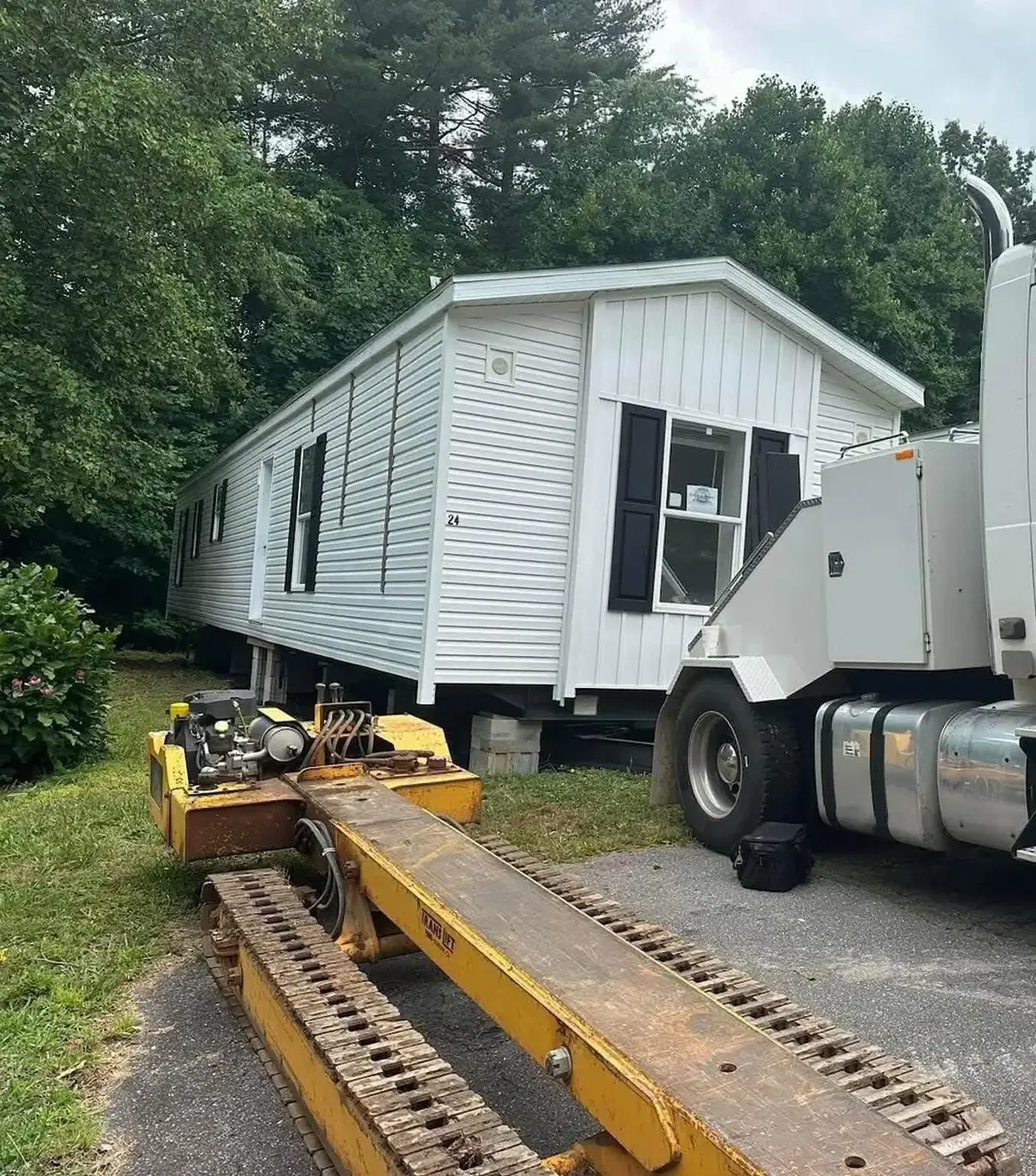
Our trucks and trailers are purpose-built for mobile home transport — hydraulic suspension, oversize-load lighting, escort coordination, and DOT-compliant rigging on every move. Not a general-cargo hauler with a “we’ll figure it out” attitude. This is what we do.
Request Your QuoteMobile Home Moving Cost Factors
What Increases the Cost
- Distance. Longer interstate routes mean more fuel, more permits, more crew hours.
- Home size. Double-wides and triple-wides require multiple loads and more permits.
- Number of states crossed. Each state requires its own oversize-load permit.
- Pilot escorts. Wider loads need front and/or rear escorts in many states.
- Difficult access. Tight driveways, low overpasses, or steep grades add time and equipment.
- Hurricane-zone anchoring. FL and coastal SC/NC require code-compliant tie-downs.
What Reduces the Cost
- Short distance. Same-county and same-state moves are the most affordable.
- Single-wide. One trailer, one permit set, faster setup.
- Easy site access. Open driveways and flat pads cut crew time substantially.
- Flexible scheduling. Off-peak weeks (winter, mid-week) often price lower.
- Bundled setup. Booking transport + setup together is cheaper than separate jobs.
Typical Cost Ranges
Single-wide local move (under 50 miles): generally $1,500 – $5,000. Double-wide local: $3,000 – $10,000. Long-distance interstate: $5 – $15+ per mile depending on size, permits, and escorts. Every quote is custom — call or request a free estimate for your exact route.
Permits, Escorts & DOT Rules We Handle
State Oversize-Load Permits
Every state requires its own oversize-load permit. Each state DOT sets thresholds, valid times, and route approvals. We file with VA, MD, DC, NC, SC, and FL on every move.
Pilot Escort Requirements
Loads exceeding 12 feet wide typically require front escorts in most Southeast states. Some routes require rear escorts. Police escorts may be needed for specific bridges.
Time-of-Day Curfews
Many states restrict oversize moves to daylight hours, weekdays only. DC has rush-hour blackout windows. We schedule routes around these to avoid violations.
Federal DOT Compliance
Interstate transport falls under FMCSA regulations including driver hours-of-service, equipment standards, and commercial vehicle inspections.
Park-to-Park Move Rules
Mobile home parks have their own rules — age limits, foundation requirements, skirting standards. We coordinate with park managers ahead of arrival.
Weight & Axle Standards
State weight limits affect axle configuration. We assess your home’s weight and frame to ensure axle count meets every state crossed on your route.
Mobile Home Movers Service Areas Explained
Virginia
As a Richmond-based company, we know Virginia’s roads, terrain, and DOT permit process intimately. From the I-95 corridor to the Shenandoah Valley, from Northern Virginia traffic patterns to coastal Tidewater routes, we plan around the realities of every region.
- Permit Office: VDOT Hauling Permits
- Common Routes: I-95, I-81, I-64, US-29
- Escort Threshold: 12’+ wide typically
- Curfew: Sunrise to sunset, weekdays
Maryland
Maryland transport requires SHA (State Highway Administration) permits and careful route planning around Baltimore tunnels, Bay Bridge restrictions, and Eastern Shore bridges. We coordinate with MdTA for toll-road transports.
- Permit Office: MD SHA Hauling Permits
- Common Routes: I-95, I-70, US-50, I-83
- Bridge Limits: Bay Bridge, Hatem Bridge restrictions
- Curfew: Weekday daylight only
Washington DC
The District has the tightest restrictions in our service area. DDOT permits, time-of-day routing windows, and Beltway-only access for oversize loads are standard. Most DC moves are transit jobs, not destination jobs.
- Permit Office: DDOT Public Space
- Common Routes: I-495 Beltway, I-295, US-50
- Restrictions: No rush-hour movement
- Escorts: Often police escort required
North Carolina
NC’s geography ranges from coastal flatlands to mountain switchbacks. We handle Charlotte metro, Triangle deliveries, Asheville mountain routes (which require special low-clearance planning), and Outer Banks coastal hurricane-zone setup.
- Permit Office: NCDOT OS/OW Permits
- Common Routes: I-40, I-77, I-95, I-26
- Mountain Routes: Low-clearance survey required
- Hurricane Zone: Coastal anchor compliance
South Carolina
SCDOT permits and a strong understanding of Lowcountry routes (Charleston, Beaufort) and Upstate routes (Greenville, Spartanburg). Coastal SC requires hurricane-zone tie-down specs similar to FL.
- Permit Office: SCDOT Oversize Permits
- Common Routes: I-26, I-85, I-95, I-77
- Coastal Setup: Hurricane-zone anchoring
- Curfew: Sunrise-sunset weekdays
Florida
Florida is our longest-haul destination. FL DOT permits, hurricane-zone wind-load requirements (Zones II and III for South FL), and statewide route planning that handles flat interstate hauls plus tight Keys access where needed.
- Permit Office: FDOT Permits Office
- Common Routes: I-95, I-75, I-10, Florida Turnpike
- Wind Zones: Zone II/III tie-downs in S. FL
- Curfew: State-specific time windows
From Our Recent Jobs
Why You Need Interstate Specialists
State Permits
Each state requires its own oversize-load permits. We file them all so you don’t have to.
Pilot Escorts
Wide loads require escorts in every state. We coordinate them on your timeline.
Route Planning
Bridge heights, low overpasses, weight restrictions — surveyed before we move.
DOT Compliance
Federal and state DOT regulations met on every interstate transport.
Reviews from Across the Southeast
“Interstate Mobile Home Movers did an amazing job moving our home. The team was professional, careful, and on time. Highly recommend.”
“They handled everything from permits to setup. The move was smooth and stress-free. Great experience start to finish.”
“The crew was friendly and very experienced. They treated our home like it was their own. Couldn’t have asked for better service.”
Service Area Questions
What are your mobile home movers service areas?
Our core mobile home movers service areas are Virginia, Maryland, Washington DC, North Carolina, South Carolina, and Florida. Interstate mobile home transport is our specialty — we move mobile, manufactured, and modular homes between these states. Each state’s permits, escorts, and DOT compliance are coordinated under one quote. If your destination falls outside these six core states, call us — we handle long-haul jobs case-by-case.
Do you move mobile homes across state lines?
Yes. Interstate mobile home transport is our specialty. We move mobile, manufactured, and modular homes between Virginia, Maryland, Washington DC, North Carolina, South Carolina, and Florida. Each state’s permits, escorts, and DOT compliance are coordinated under one quote.
How much does it cost to move a mobile home interstate?
Interstate mobile home moves typically range from $5 to $15+ per mile depending on home size, route, permits, and escort requirements. A single-wide local move (under 50 miles) generally runs $1,500–$5,000. A double-wide local move is typically $3,000–$10,000. Long-distance interstate moves are quoted custom. Request a free estimate for your specific route.
What permits are required to move a mobile home?
Every state your route passes through requires its own oversize-load permit, filed with that state’s DOT. Wide loads typically need pilot escort vehicles, and some bridges or interchanges require police escorts. We file all permits and arrange all escorts as part of your quote.
How long does an interstate mobile home move take?
Permit turnaround is typically 2-5 business days. Actual transport depends on distance: a same-state move is usually completed in one day, while a long-haul interstate move (like Virginia to Florida) can take 2-4 days including setup. We schedule around state curfew windows that restrict oversize loads to daylight hours.
Do you handle setup and re-leveling at the destination?
Yes. Our service includes full setup: positioning the home on the new site, leveling, block placement, anchoring per state code (including hurricane-zone tie-downs for FL and coastal SC/NC), skirting, and final inspection. Utility hookup is coordinated with your local providers.
Can you move my mobile home into a Florida hurricane zone?
Yes. Florida wind-zone codes (Zones II and III, primarily South FL and coastal regions) require specific tie-down anchoring and engineering compliance. We handle the transport, the Florida DOT permits, and the wind-zone-compliant setup all in one move.
What if my destination isn’t in your listed service areas?
Call us directly. We handle long-haul interstate jobs beyond our standard zones case-by-case, especially routes that originate in or pass through our six core states. Phone (434) 202-4614 to discuss.
Do you move single-wides, double-wides, and modular homes?
Yes. We transport single-wides, double-wides, triple-wides, modular homes, manufactured homes, and park models. Each type has different axle and trailer requirements, which we assess during the on-site inspection.
Related Resources
Ready to Move Your Mobile Home?
Tell us where it is, where it’s going, and the basics about your home. We respond within 24 hours with a free, no-obligation estimate.
Don’t See Your Area?
We may still be able to help. Call us directly to discuss your move — we handle long-haul interstate transports beyond our standard service zones on a case-by-case basis.